







The Science of Ageing. Helping Us Live Healthier for Longer
What is ageing?
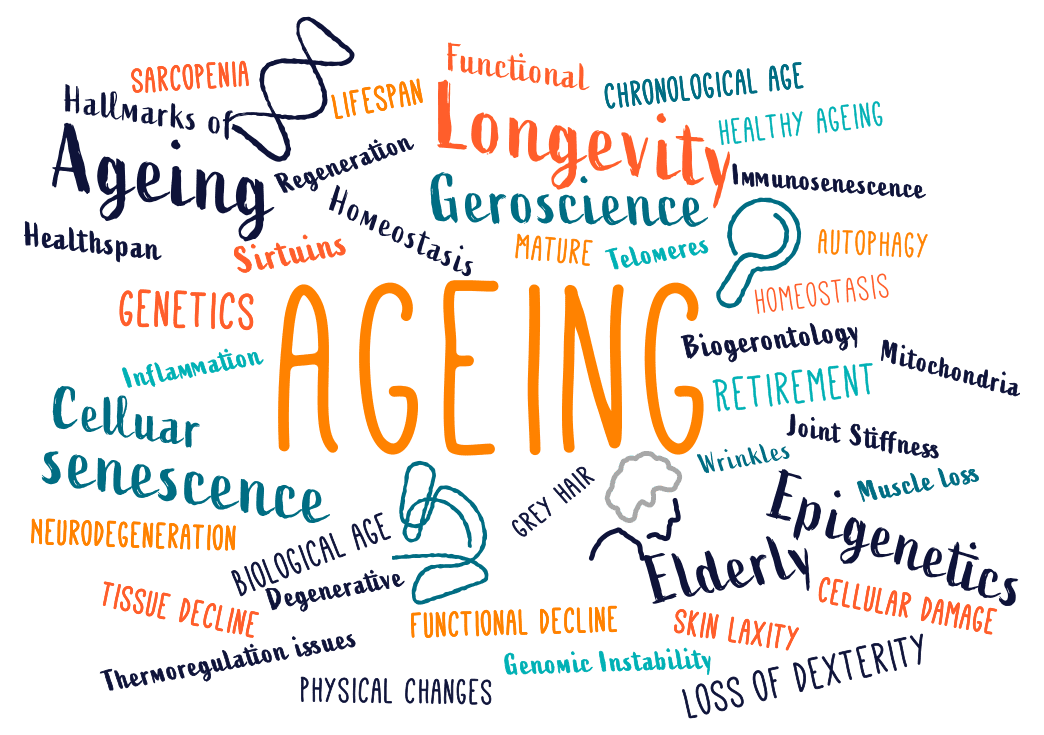
So many words and phrases come to mind. What does ageing mean to you?
Perhaps you think of the word ‘longevity', or 'longevity research' which is everywhere at the moment and becoming somewhat of a buzzword and phrase.
Perhaps you think of what happens with age, from the more obvious physical changes on the outside, or perhaps you think of the less obvious and more subtle changes that cannot be seen but are happening inside our cells.
One thing is for sure, and I think we all agree, is that ageing is complex.
Ageing is multifactorial, with so many interconnected pathways that are thought to be driving the ageing process, resulting in physical signs of ageing.
Ageing is heterogeneous.
We all age differently. Tiny nematode worms live for approximately a couple of weeks, small fruit flies a little longer, and mice live for a few years. Elephants have much longer lifespans of approximately 70-80 years. There are some outliers which are intriguing to study; for example, the Naked Mole Rat, which lives for approximately 30 years, significantly longer than other rat species. Humans age differently to other animals; individuals within the same species age differently. Tissues within the same individual age differently.
If you pause and think about what ageing means to you, do the reasons we age and the biology of ageing spring to mind?
You may think about ageing on a societal level: ageing populations, advances in healthcare allowing for longer and healthier lives; 100 years ago we weren’t seeing the same lifespans we are today. When thinking about what ageing means, you may think of older family or friends, intergenerational connections, shared experiences with people with more life experience.
A whole field of science is dedicated to the biology of ageing: biogerontology. Whilst there are numerous ways to describe ageing, one definition of ageing is “the progressive loss of physiological integrity, leading to impaired function and increased vulnerability to death”. This definition explains the decline that occurs with age and loss of independence.
Whilst this sounds quite doom and gloom, biogerontology studies the mechanisms of ageing and the evolutionary theories of why we age, providing the potential to test interventions to slow ageing and help people live healthier for longer.

Why are we talking about ageing?
There has always been a human desire to look and feel younger, to search for the ‘fountain of youth.’ The science of ageing has been researched for decades, with much pioneering research in the field. However, it has really gained significant momentum over the past 10 years.
Knowledge in the field is increasing; technology has advanced, and collaboration across disciplines has grown, meaning more people are working together. Funding for research and industry investment in ageing has increased, bringing more interest to mainstream media.
Many unknowns remain, so more collaboration and funding are still required.
Focusing on ageing matters not only from an individual’s perspective; it also matters from an economic and societal perspective. On the surface, focusing on ageing might seem like a niche topic, but once you pause to think, ageing is broad and multidisciplinary.

Lifespan and Healthspan
Why am I asking what ageing is?
Why does it matter?
When you think of ageing, you may think of ‘lifespan’: the number of years a person lives. Lifespan seems like the obvious way to measure ageing. But what about the number of years spent in good health, our ‘healthspan’?
Researching ageing matters because the global population is ageing, lifespans are getting longer, but healthspan has not increased enough to optimise quality of life2.
When people are asked ‘would you like to live longer?’ it is often received negatively, as if the question implies being in prolonged pain.
The goal in the ageing field? To square the healthspan curve, to increase the proportion of life in good health.

Figure 1. The aim of ageing research is to square the healthspan curve, to maximise life in a disease-free state, and minimise the latter stages of life in ill health.
Delving deeper into researching how we age, and what mechanisms potentially cause the ageing process, is important because it allows research into what can be done to intervene and delay the onset of many age-related diseases or prevent the consequences of ageing.
Ageing is a risk factor for many noncommunicable diseases, such as cardiovascular disease, dementia, cancer, Parkinson’s Disease, type 2 diabetes, sarcopenia and many more. Research indicates that many of these age-related diseases, currently treated separately, share common root causes. The common root cause is the molecular and cellular mechanisms of ageing. Targeting the ageing process could reduce multi-morbidity (having 2 or more long-term health issues simultaneously) and poly-pharmacy (taking multiple medications at the same time). Both multi-morbidity and poly-pharmacy are common with increasing age.
To be able to treat earlier, intervene, and go by the ‘prevention is better than cure’ mentality, it suggests an approach to tackle the ageing population and keep people healthier and independent for longer. Societal impact, relieving pressure on the NHS and the economy.

References:
1. Lopez-Otin, C., Blasco, M. A., Partridge, L., Serrano, M. and Kroemer, G. (2013) 'The hallmarks of aging', Cell, 153(6), pp. 1194-217.
2. Jaul, E. and Barron, J. (2017) 'Age-related diseases and clinical and public health implications for the 85 years old and over population', Frontiers in Public Health, 5, pp.335.
Arttia Creative Supporting Ageing Research
At Arttia Creative, we help companies working at the forefront of ageing, longevity and regenerative medicine communicate complex science with clarity, credibility and impact. This is a rapidly evolving space, with organisations exploring areas such as NAD biology, DNA repair, cellular regeneration, healthy ageing and the hallmarks of ageing. Our team combines scientific expertise, biotech consultancy, strategic thinking, design and digital marketing to translate these highly technical areas of research into compelling brand stories, clear messaging and engaging digital experiences.
As discoveries move from the laboratory towards clinical, commercial and consumer applications, organisations like yours need to explain not only what their science does, but why it matters. Arttia Creative supports companies developing technologies, therapeutics and platforms around regenerative medicine, metabolic health, cellular repair and other mechanisms linked to the hallmarks of ageing.
Through brand strategy, brand design, website design, scientific content, digital campaigns and investor-facing communications, we help businesses position their research, communicate differentiation and build the credibility needed to attract partners, investors, collaborators and customers.
Commercialising research in healthy ageing requires a careful balance between scientific accuracy and accessible communication. Claims around NAD, DNA repair, longevity and regenerative medicine need to be presented responsibly, while still conveying the potential and significance of the innovation.
Arttia Creative helps organisations like yours to turn complex research into a coherent commercial story, strengthening positioning, building trust and creating the communications and digital marketing needed to move from scientific discovery to market opportunity.