
Getting It Right from the Start: “The Importance of a Well-Validated ELISA"
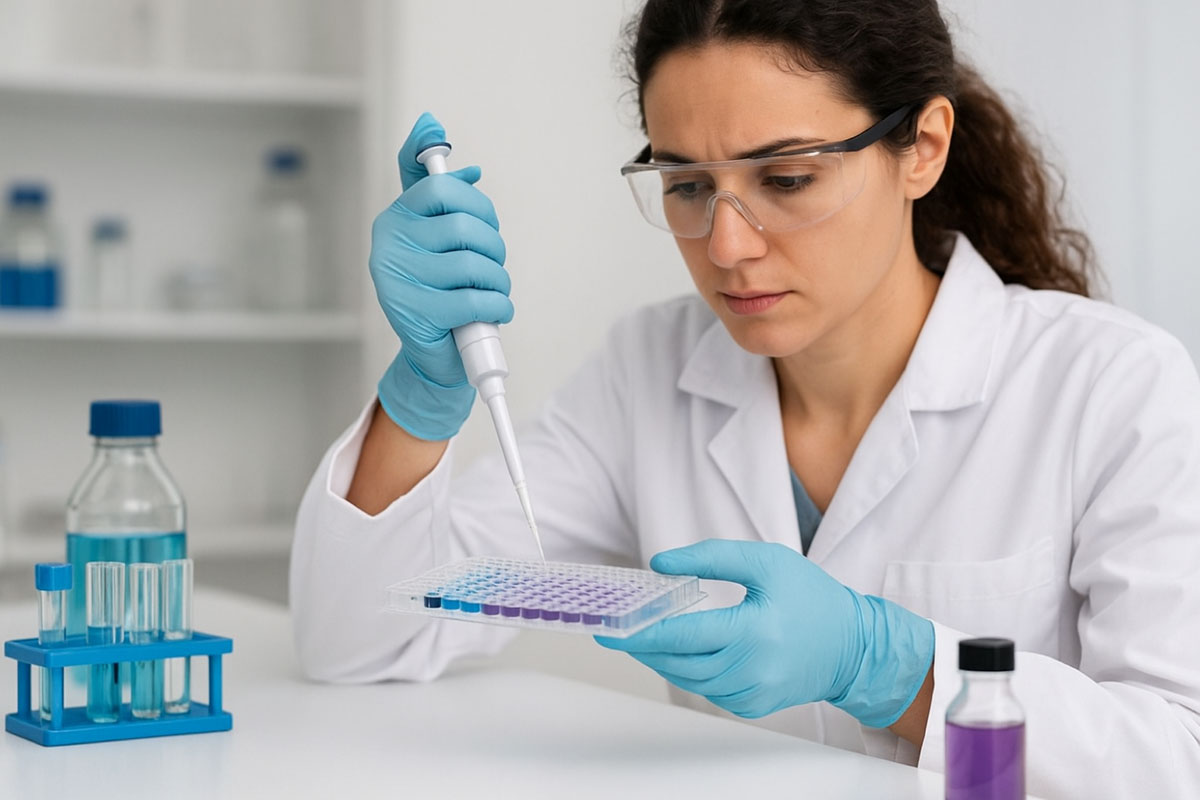
At Ab Biotechnology, we’ve developed and validated many ELISAs for analytical testing over the years; for in-process monitoring of production, and lot release and stability testing of final products. But what does it mean to develop a robust ELISA and why is validation so important?
The First Step towards Validation is…. Development!
Before starting any validation work you should have already done substantial development work. That’s where our in-house assay development team really steps up – this is their bread and butter!
During assay development, there are quite a few key questions our team need to think about. For starters: what’s the purpose of the assay? Do we need a precise, quantitative result? If so, what kind of range are we looking at? Or would a limit test be enough — like just detecting the presence of impurities?
The development approach requires careful planning and optimization of each step to ensure a strong signal and low background for reliable results. Here are a few key things we focus on:
Assay design — Should we go with a direct, indirect, competitive, or sandwich format?
Component selection — We need to choose the right coating antigens or antibodies, blocking agents, diluents, wash buffers, and detection antibodies. All of these need to work well together.
Optimization of concentrations — We adjust each component to:
o Minimize background noise or non-specific binding
o Maximize signal strength
o Ensure the assay has the right dynamic range
Controls and standard curves — These are essential for reliability and consistency.
Robustness testing — We test how small changes (like incubation times or temperatures) affect performance.
When all of these have been investigated and our assay looks good to go, we then do a pre‑validation check, a mini-validation, before entering to the validation phase. In pre-validation we will check the accuracy, the precision and the specificity of the assay. Only when the pre-validation has passed do we enter the validation phase.
What is Assay Validation, Really?
At first glance “validation” might sound a bit intimidating, but to be honest you should have answered a lot of the questions during your development/pre-validation.
The goal of validation is to show that the ELISA method is reliable and fit for its intended purpose. But what does that mean in practice, what do we actually test during validation?
That also depends on the method but the standard guidance comes from ICH Q2 (R2). Generally, though, here are some of the key things we look at for a quantitative ELISA method:
Accuracy – How close the assay results are to the true value, across the range?
Precision – How consistent are the results? Within the same assay (intra-precision) Between different assays, days, operators, equipment, and even sites (inter-precision or reproducibility)
Specificity/Selectivity – Could anything in the sample interfere with the results? Think impurities, breakdown products, or components of the matrix.
Dilutional Linearity – If you dilute the sample, do the results still make sense? Is there a linear relationship between concentration and response?
Sample Stability – Especially critical for clinical and pre-clinical samples. Will the sample stay stable long enough to get accurate results?
Documenting the Results
Once validation is complete, the findings are put together in a report that clearly shows whether the method met the required criteria. This makes it easy to see if the assay is ready to be used confidently.
When Do You Need to Re-Validate?
Great question! Re-validation might be necessary if:
You make changes to the ELISA method or there is a change to the regulatory requirements
There are changes in equipment/software, reagents, or even testing sites
Or you start applying the method to a new sample type
Re-validation ensures that the assay continues to deliver accurate, precise, and reliable results under new or modified conditions.
The Take Home Message
At Ab Biotechnology, we don’t just build assays—we build confidence.
Our team specializes in developing and validating robust, high-performance ELISAs tailored to your program’s needs. Whether for regulatory submission, QC, or discovery, we design every assay with purpose and precision—ensuring your data is reliable, reproducible, and ready for the next step.
Please get in contact if you would like to see how we can support your projects.
enquiries@abbiotechnology.com