From Cotton to Qubits: Why Manchester is the next global science superpower
For the past few years, the conversation around UK science and innovation has been dominated by the “Golden Triangle”. But there is another city that has earned its seat at the global science table and that city is Manchester.
World renowned for its music and cultural influence, most recently on show at The Brits at the Co-Op Live Arena, Manchester’s creative reputation is well established. What is less widely appreciated is the scale and pace of its scientific resurgence and the city’s growing importance on the global innovation stage should not be underestimated.
Manchester is no longer “catching up”. It is firmly seated at the top table of science and innovation. The city that gave the world the first inter-city railway and split the atom is now helping to build the future of graphene, genomics, and quantum science.
The data speaks for itself.
Greater Manchester’s economy has surpassed the £100 billion GVA mark, consistently outpacing the UK’s average growth rate for nearly a decade. If you look at what is powering this, it’s tech, digital and advanced manufacturing; all sectors that continue to grow in importance across the global economy.
And with a 50% graduate retention rate, the highest in the UK outside London, Manchester has also built a talent pipeline that is fuelling more than 10,000 digital and science-based businesses across the city-region.
In artificial intelligence, Manchester leads the UK in percentage growth, recording a 184% increase in AI-focused company registrations over the last five years. The city’s AI ecosystem is now valued at over £5 billion, and programmes such as the Turing Innovation Catalyst are playing a critical role in accelerating this momentum and are increasingly studied as models for regional innovation.
At Kadans Science Partner , we no longer benchmark Manchester against London or Cambridge. Instead, it stands alongside global innovation heavyweights such as Boston’s Kendall Square, Pittsburgh’s Robotics Row, and Eindhoven’s High Tech campus. Much like these cities, Manchester has successfully pivoted from a legacy industrial base to a “Deep Tech” economy, outperforming peers like Amsterdam in unicorn production per capita.
Scientific credibility underpins this growth.
Researchers at the The University of Manchester recently produced the world’s purest silicon, arguably one of the most significant breakthroughs in the past few years in quantum computing. This foundational material paves the way for scalable quantum computing to fabricate one million qubits at the size of a pin head.
Groups like Unit M , the University of Manchester’s innovation arm, are pioneering new ways of connecting industry and academia. Innovation is a contact sport and maintaining a constant flow of ideas, talent and capital, both in and out of the university, is essential to sustained success.
Despite AI, tech and data changing our lives every day, the need for highly technical real estate for science and innovation companies has never been more apparent and we have seen this first hand.
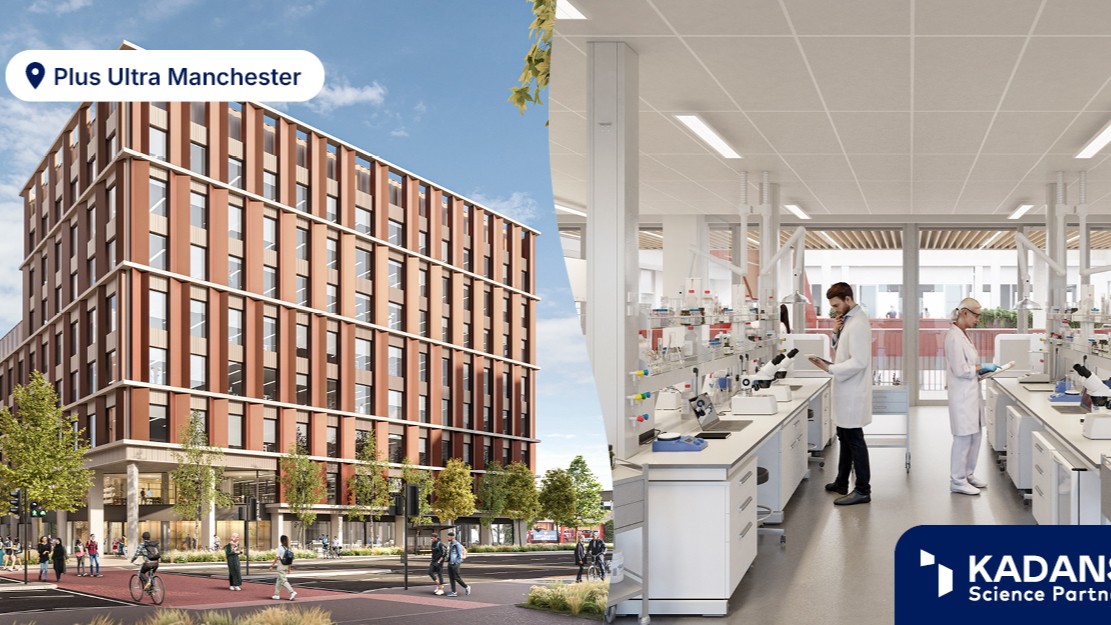
Kadans Science Partner Plus Ultra Manchester is a £100 million + investment, which, once complete, will provide 217,000 sq ft of multidisciplinary lab space. It’s the centrepiece of a wider £450 million masterplan on Upper Brook Street, and is a response to the sustained demand from companies choosing to build and scale in the North.
Manchester’s story has always been one of reinvention, from John Dalton’s atomic theory published in 1803 to the quantum breakthroughs we can only imagine. Each era has been defined by the ability to translate discovery into significant change.
The question now is not whether Manchester can compete globally, it is whether the UK and international investors are prepared to back it at the scale required to lead.