
Advancing In Vivo CAR-T: The Questions That Matter
CAR-T therapy has transformed the treatment landscape for several haematological malignancies, but its wider use remains constrained by the complexity of manufacturing cells outside the patient.
In vivo CAR-T therapies aims to change that. Rather than removing and engineering T cells ex vivo, in vivo approaches deliver CAR-encoding material directly into the body, allowing T cells to be programmed within the patient.
As these technologies move towards the clinic, they create a different set of preclinical questions. Demonstrating that a vector has been administered successfully is only the beginning. A meaningful study needs to connect delivery, CAR-T generation, cellular activity, efficacy and safety.
Did the therapy generate the intended CAR-T cells?
Unlike conventional CAR-T therapy, where the final cellular product can be characterised before dosing, in vivo CAR-T generates the therapeutic cells inside the subject.
Preclinical evaluation therefore needs to establish whether CAR-positive cells are successfully generated following treatment.
This may include measuring CAR-positive T-cell populations, CD4+ and CD8+ subsets, vector distribution and CAR expression over time.
Humanised mouse models can be particularly useful because they allow CAR generation and immune-cell behaviour to be assessed within an in vivo system containing relevant human immune populations.
Do the CAR-T cells expand and persist?
Generating CAR-positive cells is only one part of the picture.
Their subsequent expansion and persistence can influence both the depth and duration of therapeutic response.
Repeated peripheral blood sampling and flow cytometry can help answer important questions:
- How quickly do CAR-positive cells appear?
- How extensively do they expand?
- How long do they remain detectable?
- Is expansion associated with dose and efficacy?
Understanding these relationships can support dose selection and help identify useful pharmacodynamic markers for later development.
Does this translate into efficacy?
Cellular pharmacodynamic measurements need to be interpreted alongside meaningful disease endpoints.
In oncology, these may include tumour volume, bioluminescence imaging, survival or other tumour-specific readouts.
A recent PharmaLegacy study illustrates this approach.
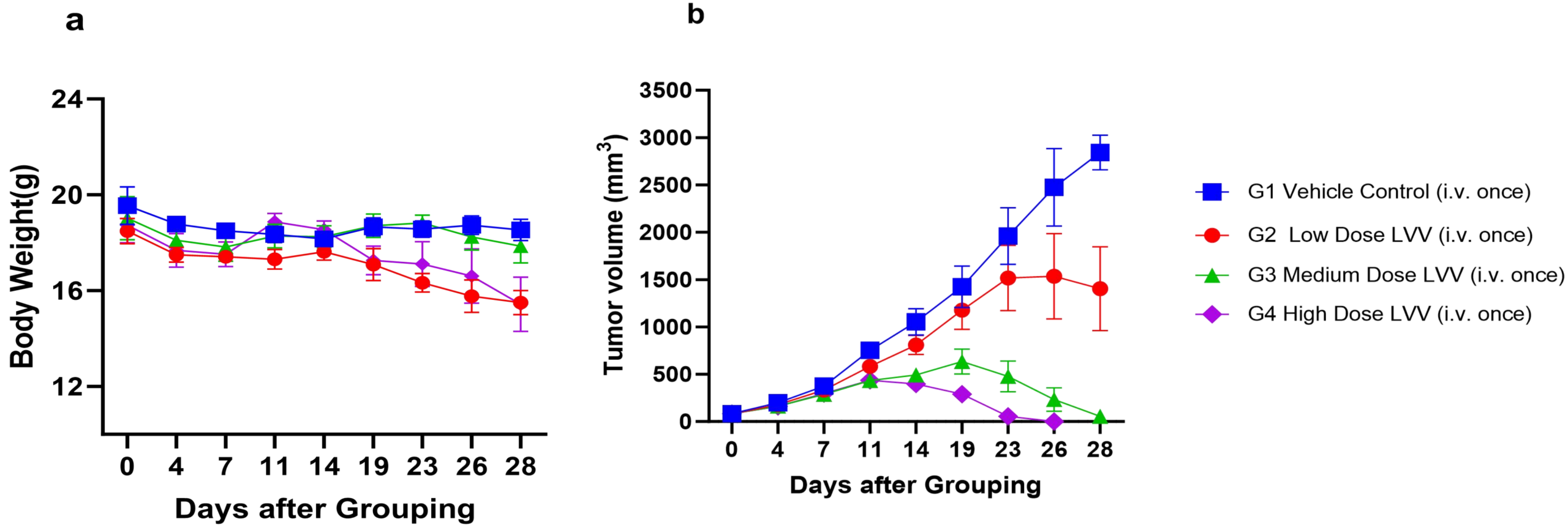
An in vivo CAR-T candidate was evaluated in a Hep3B human liver cancer model using humanised mice across vehicle, low-, medium- and high-dose groups.
The treatment produced a clear dose-dependent antitumour response. Low and medium doses suppressed tumour progression, while complete tumour regression was observed in the high-dose group.
At the high dose, CAR-positive cells within the human CD45+ population peaked at approximately 70% on Day 14 and remained at around 60% through Day 28.
This allowed the study to connect dose, CAR-T generation, expansion and persistence with antitumour activity, providing a much more informative dataset than measuring tumour response alone.
You can view the full case study on the PharmaLegacy website here.
What does the safety profile look like?
The same immune activation that drives efficacy can also contribute to toxicity.
Preclinical studies therefore need to assess safety alongside activity.
Depending on the programme, this may include cytokine profiling, haematology, clinical chemistry, histopathology and vector biodistribution.
The aim is not simply to identify the most efficacious dose, but to understand the relationship between biological activity and tolerability.
Building a connected preclinical package
There is unlikely to be a single model that answers every question associated with in vivo CAR-T development.
Different targets, tumour types and vector technologies will require different approaches.
The key is to select a model around the development question and generate a connected dataset covering CAR-T generation, persistence, efficacy and safety.
As in vivo CAR-T continues to move into clinical development, this integrated approach will be increasingly important in supporting decisions around dose, candidate selection and translational strategy.
About PharmaLegacy Laboratories
PharmaLegacy Laboratories is a global preclinical CRO supporting biotechnology and pharmaceutical companies across disease pharmacology, DMPK/PK, toxicology and translational research.
Its cell and gene therapy capabilities include humanised mouse models, in vivo CAR-T efficacy studies, immune-cell profiling and bioanalysis.
For enquiries, contact:
Jack Shepherd, Manager, Business Development – UK & Europe, PharmaLegacy Laboratories.
jack.shepherd@pharmalegacy.com